
Strategy
Hale AI Implementation at a Value-Based Care Organization: Partnering with Clinical Coaching to Scale Training
Care management teams are under relentless pressure to improve outcomes, coach clinicians effectively, and maintain quality at scale. But too often, operations are slowed by inconsistency, manual review, and limited visibility into performance.

That is where Hale AI changes the equation.
In a seven-month deployment with a healthcare organization with a large staff of telephonic care management RNs, Hale AI helped enhance training and performance development through realistic simulation, objective scoring, and coaching-ready insights.
Most care management organizations are not short on talent. They are short on scalable systems for developing it.
Telephonic nurses often come from different specialties and must quickly operate as generalists across complex disease states, medications, escalation thresholds, and behavior-change conversations. That creates avoidable variation in call quality, plan-of-care development, and medication review.
Traditional coaching methods add even more friction. Live-call shadowing is often inconsistent, difficult to schedule, and incomplete. Hale AI’s customer described shadowing as “hit and miss,” limiting leaders’ ability to coach reliably on motivational interviewing, soft skills, and clinical structure.
Hale AI addresses these inefficiencies by giving teams a repeatable environment to practice difficult encounters, surface hidden gaps, and standardize feedback. Instead of relying on sporadic observation, leaders get objective evidence tied directly to performance.
“Hale AI was the only way to get a good view of how the nurse is talking to the patient—especially around MI and soft skills.”
— Clinical coach
Hale AI improves efficiency in three powerful ways:
Hale AI creates realistic encounters that reflect patient complexity, emotional pushback, and critical clinical decision points. This reduces ambiguity and makes performance measurable across the team.
Each simulation is converted into structured scores, evidence-backed examples, and targeted guidance. Leaders spend less time piecing together subjective impressions and more time delivering focused coaching.
By replacing inconsistent shadowing with always-available performance visibility, Hale AI gives managers a scalable way to reinforce quality without overloading leadership teams.
“Nurses sometimes have a mental block with a coach. Hale AI removes the barrier—they see the feedback objectively, and they see their own words.”
— Clinical coach
Hale AI’s value showed up not just in immediate improvement, but in performance that carried forward. Clinicians with prior Hale AI experience scored about 7% higher overall than those without it, with especially strong gains in diagnostic accuracy (+12%), medication review (+19%), medication reconciliation (+20%), and coverage of non-prescription medications (+18%). In other words, Hale AI was not just helping nurses practice—it was helping them retain and apply what they learned.
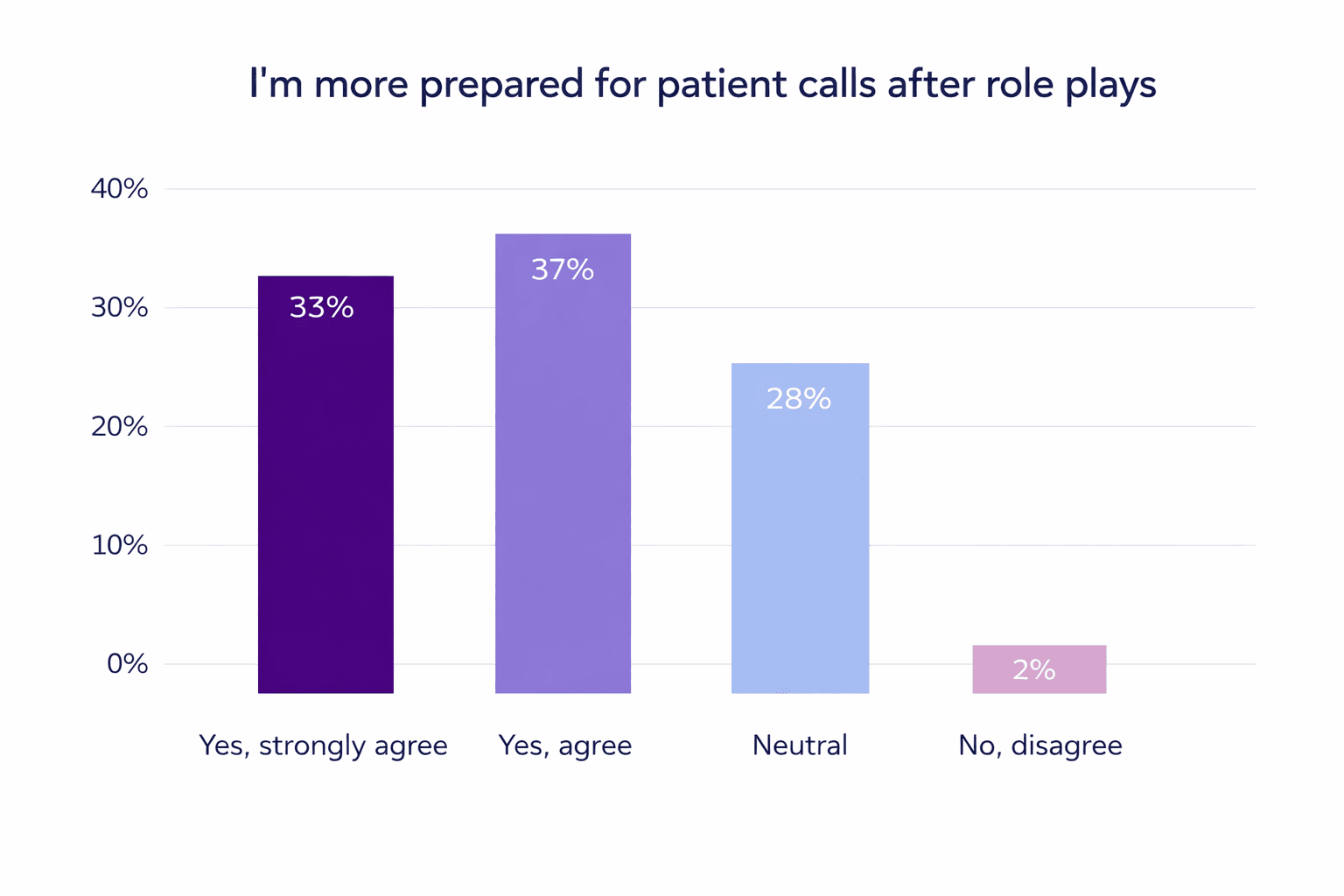
Preparedness improved, too. Among 184 RNs, about 70% said role plays made them feel more prepared for real patient calls, including 33% who strongly agreed and 37% who agreed.
“I didn’t realize I was missing the OTC medication check in my daily calls. The sim brought up things I was missing that I didn’t even think I was missing.”
— Registered nurse
Hale AI does not simply make workflows faster. It makes care management operations more disciplined, more measurable, and more effective. In this deployment, ~70% of surveyed respondents indicated that the simulations and assessment reports had improved their real clinical practice.
“Going into the first sim, I was not looking forward to it—I’m not tech savvy—it stretches your skills…makes you dig into the labs that you otherwise don’t…something like this was great telling us what our calls should look like…thoroughly enjoyed the experience.”
— Registered Nurse
Hale AI Implementation at a Value-Based Care Organization: Partnering with Clinical Coaching to Scale Training

How Is Hale AI Beneficial for Nurses?

How Is Hale AI Beneficial for Clinical Coaches?

Simulations That Build Real-World Clinical Skills: How Hale AI Prepares Clinicians for the Conversations That Matter
Real-World Evidence Supporting Hale AI’s Approach to Clinical Training