
Strategy
Hale AI Implementation at a Value-Based Care Organization: Partnering with Clinical Coaching to Scale Training
Nurses frequently navigate complex patient conversations that demand strong clinical reasoning, clear communication, and effective care planning. Hale AI empowers nurses to build these skills through AI-powered clinical simulations, enabling them to practice realistic patient interactions in a safe, controlled environment before applying them in real-world clinical settings.

Over a 12-month implementation with a large value based care organization involving ~300 telephonic care management nurses, Hale AI enabled clinicians to practice realistic, high-complexity patient interactions in a safe simulation environment. These simulations not only mirrored real-world challenges—such as patient pushback, disengagement, and emotionally charged scenarios—but also translated each interaction into structured scoring, actionable feedback, and coaching-ready insights, helping nurses strengthen both clinical and conversational skills before applying them in real care settings.
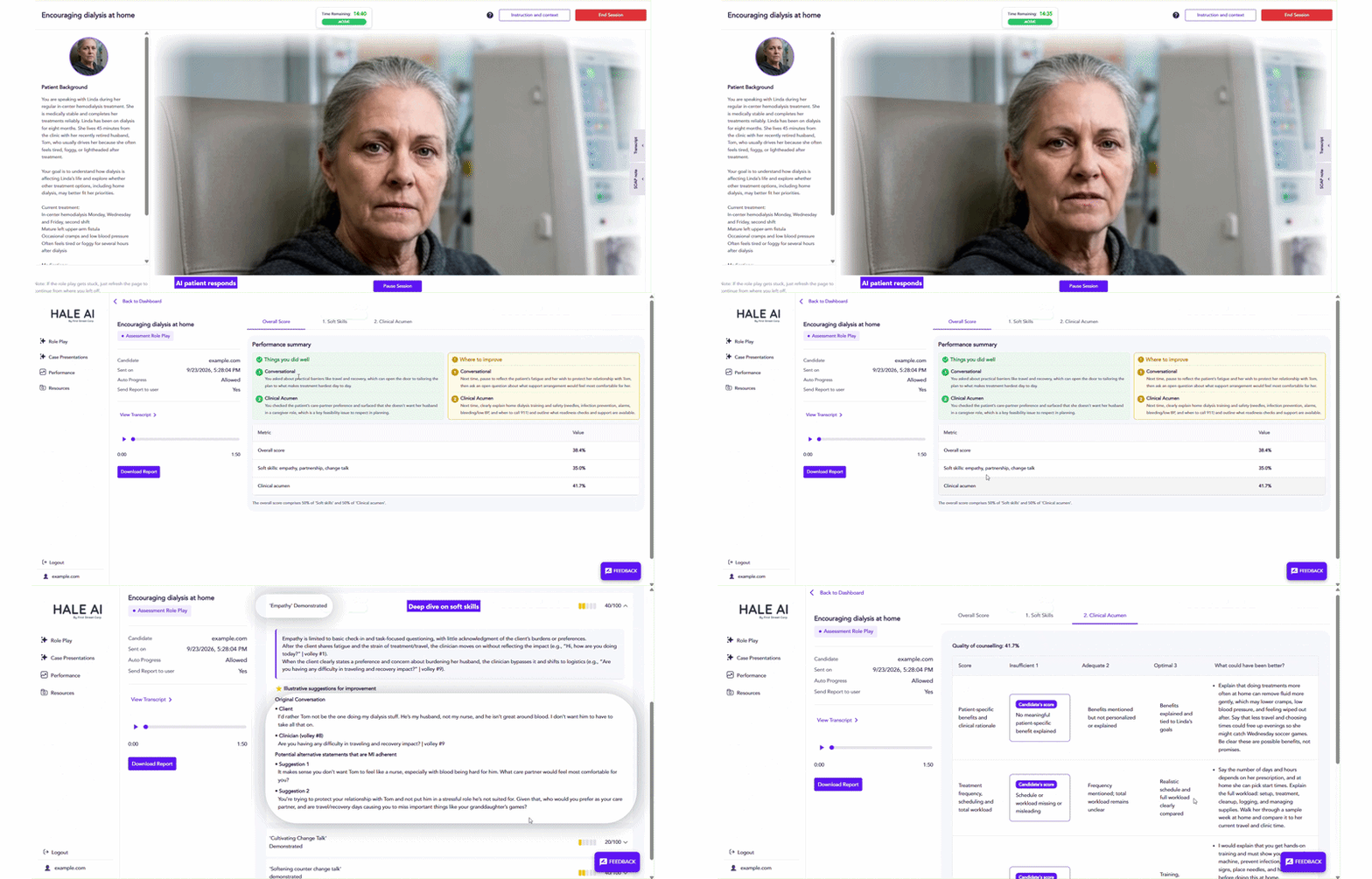
Implementation of Hale AI revealed clear, measurable improvements in nurse performance over time. With repeated simulation practice and targeted coaching, nurses demonstrated significant gains across key clinical competencies over the course of ten simulations.
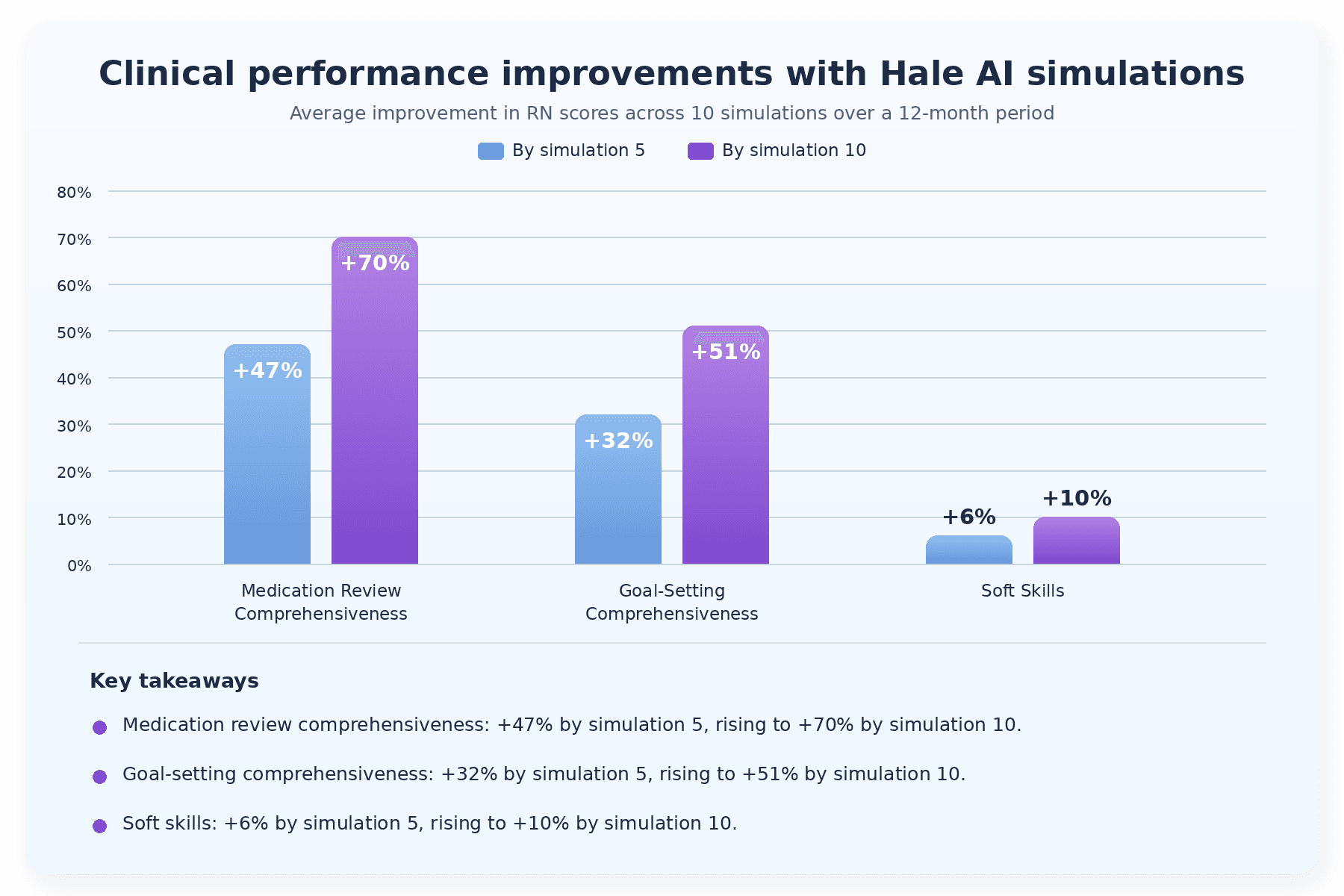
This improvement in medication review highlights how structured simulation and feedback can strengthen critical clinical workflows that are often overlooked in routine practice.
Hale AI also helped nurses uncover gaps in their everyday patient interactions. Many realized they were missing key steps—such as checking over-the-counter medications or thoroughly reviewing lab values.
“I didn’t realize I was missing the OTC medication check in my daily calls. The sim brought up things I was missing that I didn’t even think I was missing.”
— Registered Nurse
“It also pushed me to get more comfortable digging into labs and medications—and to be more direct with patients about what they should do.”
— Registered Nurse
By surfacing these gaps with real conversational evidence, Hale AI enables nurses to improve both clinical decision-making and patient guidance.
The impact extends beyond immediate improvements. Nurses with prior experience on the platform scored 7% higher overall, especially in diagnostic questioning and medication reconciliation—indicating that repeated simulation may reinforce long-term clinical behavior.
70% of nurses surveyed reported feeling more prepared for real patient calls after completing simulations, highlighting a significant boost in confidence alongside skill development.
Furthermore, ~80% of nurses surveyed indicated that the simulations and assessment reports had improved their real clinical practice.
Hale AI Implementation at a Value-Based Care Organization: Partnering with Clinical Coaching to Scale Training

How Is Hale AI Beneficial for Clinical Coaches?

Simulations That Build Real-World Clinical Skills: How Hale AI Prepares Clinicians for the Conversations That Matter

How Does Hale AI Help Drive Operational Efficiency in Care Management Operations?
Real-World Evidence Supporting Hale AI’s Approach to Clinical Training